How to Create a Voice Agent from a Template
Last updated: May 21, 2026
With Voice Agents, Fireflies can run meetings on your behalf, including screening interviews, sales discovery calls, and user research. while still capturing structured notes, summaries, and insights from every call.
To get started quickly, select one of the built-in templates such as the Screening Interview Agent, Discovery Call Agent, or User Research Agent. Each template comes pre-configured with questions and structure for its use case. You can edit everything before publishing.
🚀 Follow these steps to create a Voice Agent
1. Choose a Voice Agent template
From your Fireflies dashboard, click on the Voice Agents tab in the left-hand menu. This is where all your Voice Agents are listed and managed.
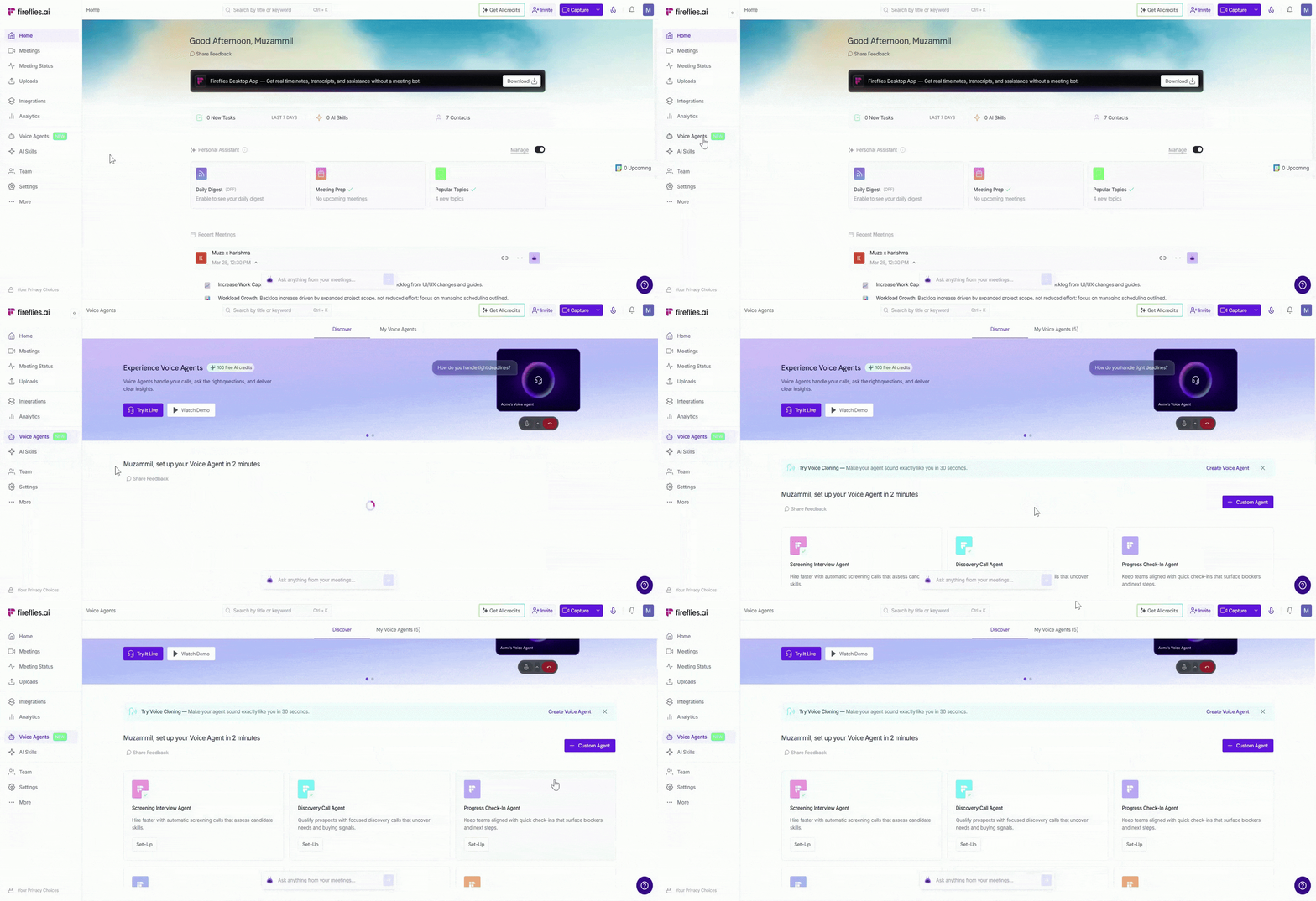
In the Discover section, you’ll see a list of available Voice Agent templates. Choose a template that’s closest to the type of conversation you want to run (for example, Screening Interview Agent or Discovery Call Agent).
Click Set up to open the template and start customizing it to fit your needs
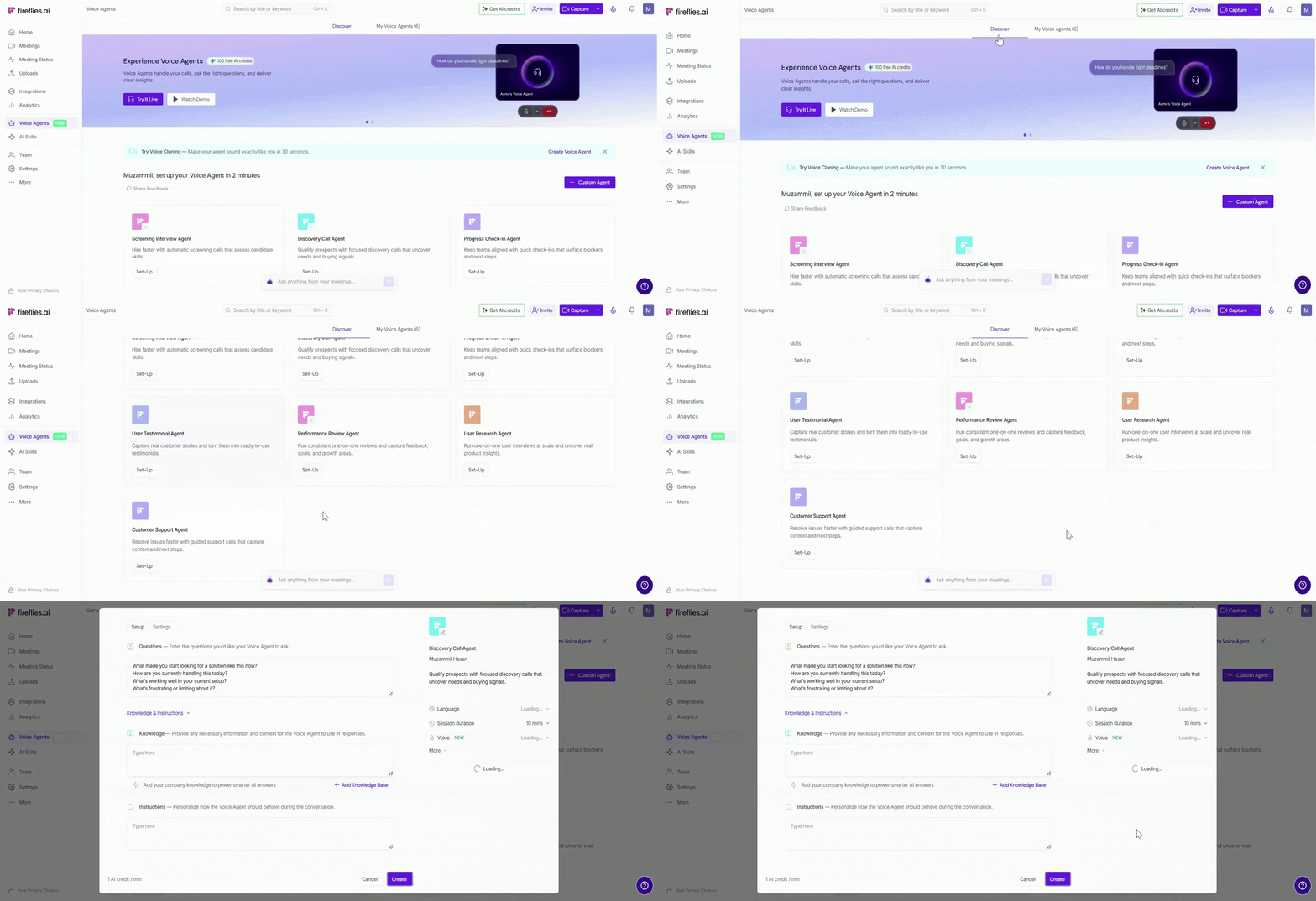
📌 For demonstration purposes, we’ll use the Discovery Call Agent template in this guide. This template is designed to qualify prospects through focused discovery calls that help uncover needs and buying signals.
You can follow the same steps with any other Voice Agent template.
2. Add questions, knowledge, and instructions
This step is where you fine-tune how the template works for your specific needs. You can keep the default content or edit it as needed.
You don’t need to get everything perfect on the first try — you can always update these later.
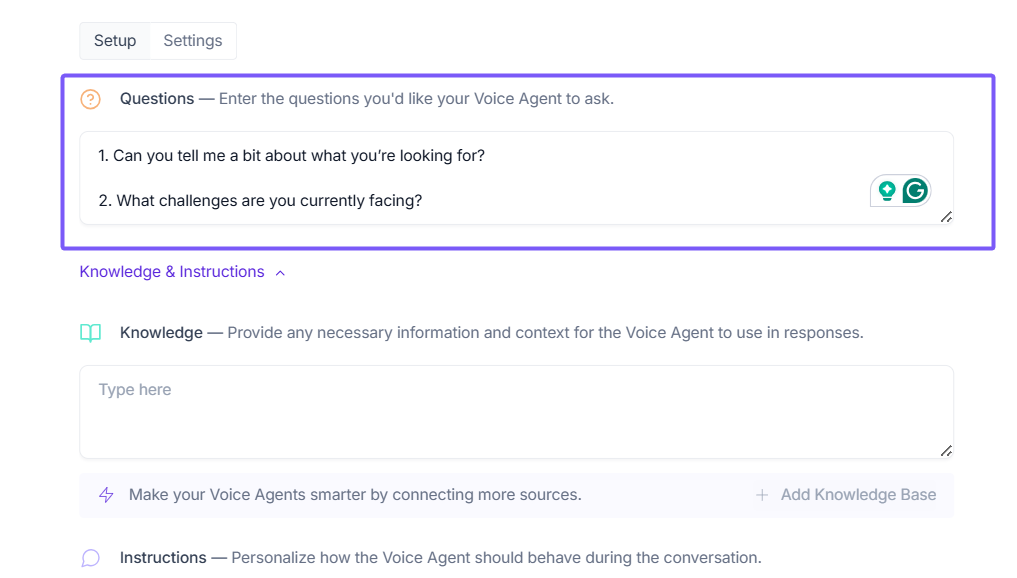
❓ Questions — What your Voice Agent will ask
Add the questions you want your Voice Agent to ask during the conversation. These questions guide the flow of the conversation and help your Voice Agent collect important information during the call.
By default, a few sample questions may already appear here, which you can edit, remove, or replace based on your use case.
Example
“Can you tell me a bit about what you’re looking for?”
“What challenges are you currently facing?”
Write questions the way a person would naturally speak.
🧠 Knowledge — What your Voice Agent should know
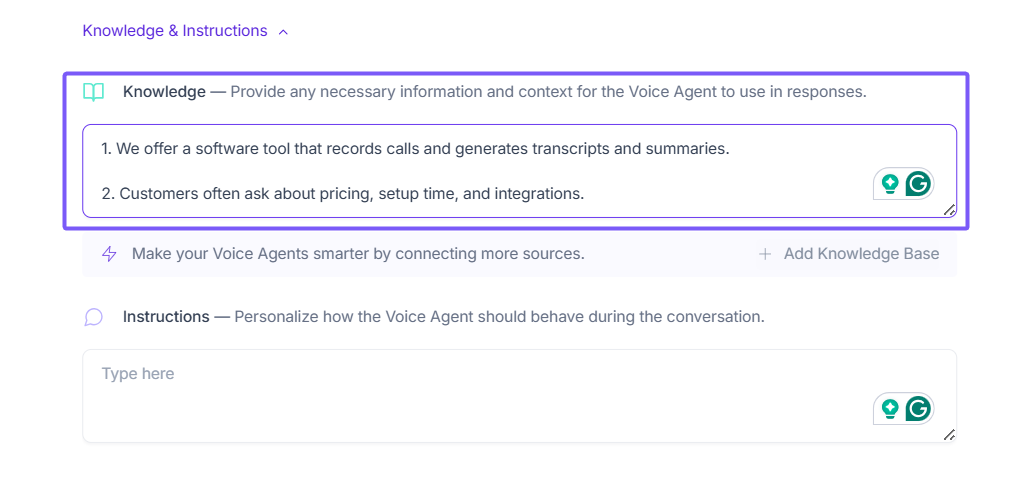
Use Knowledge to give your Voice Agent helpful background information it can refer to during the conversation.
How to use it:
Add short, clear information
Include facts the agent may need to explain
Avoid long paragraphs
Example
“We offer a software tool that records calls and generates transcripts and summaries.”
“Customers often ask about pricing, setup time, and integrations.”
📚 Add a Knowledge Base to your Voice Agent
You can make your Voice Agent smarter by connecting a Knowledge Base. This allows the agent to reference documents, FAQs, playbooks, or internal content while responding during a call—so answers stay accurate and aligned with your business context.
How it works
In the Knowledge section, you can add written context directly, or
Click Add Knowledge Base to connect an existing Knowledge Base or add a new base directly from here.
The Voice Agent will use this information in real time while responding to participants
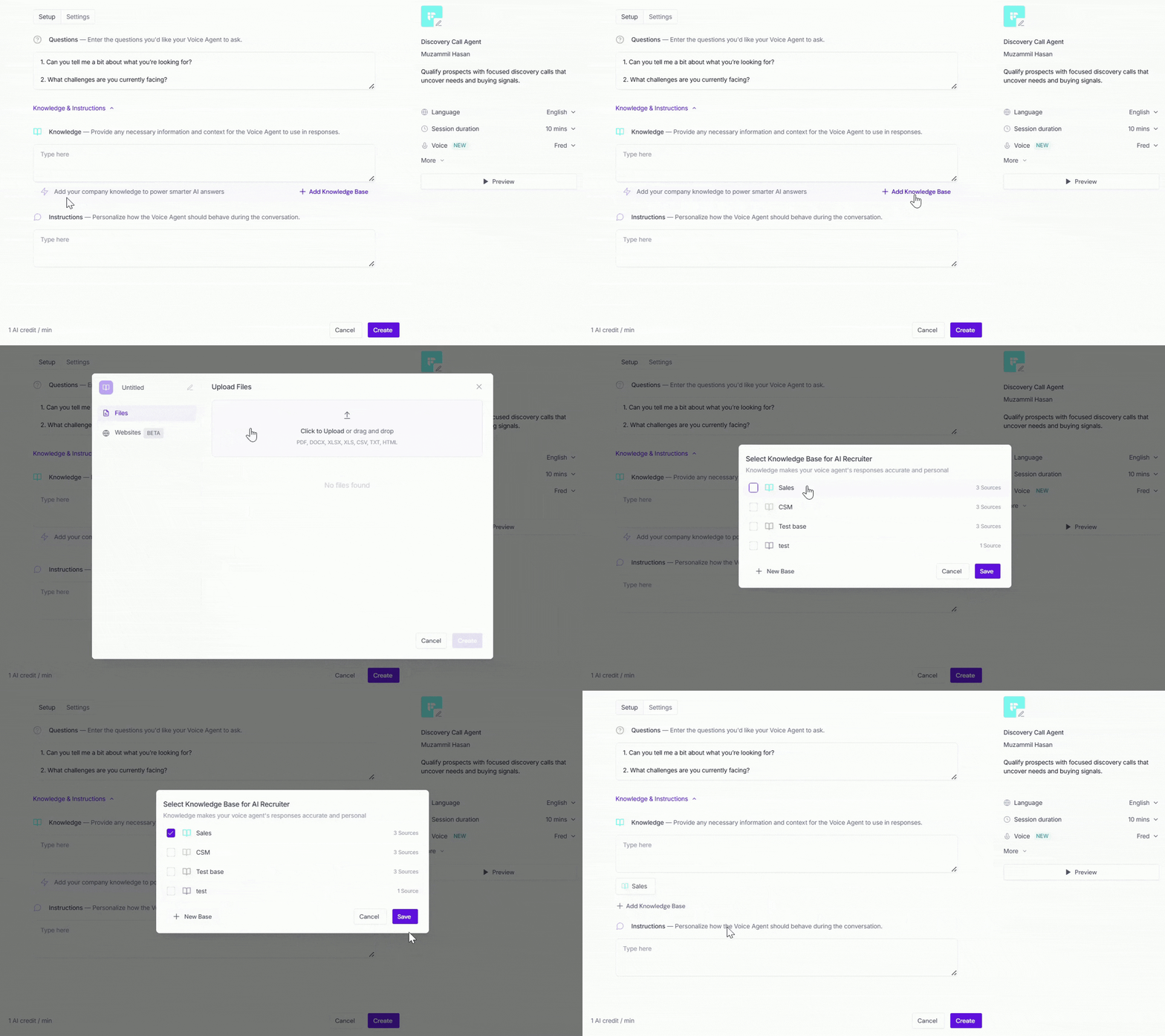
This is especially useful when your Voice Agent needs to answer questions about products, policies, pricing, or internal processes without hardcoding everything into prompts.
Example
A Screening Interview Voice Agent can reference hiring policies, while a Discovery Call Voice Agent can pull from sales FAQs or product documentation.
👉 Learn more about setting up a Knowledge Base for Voice Agents
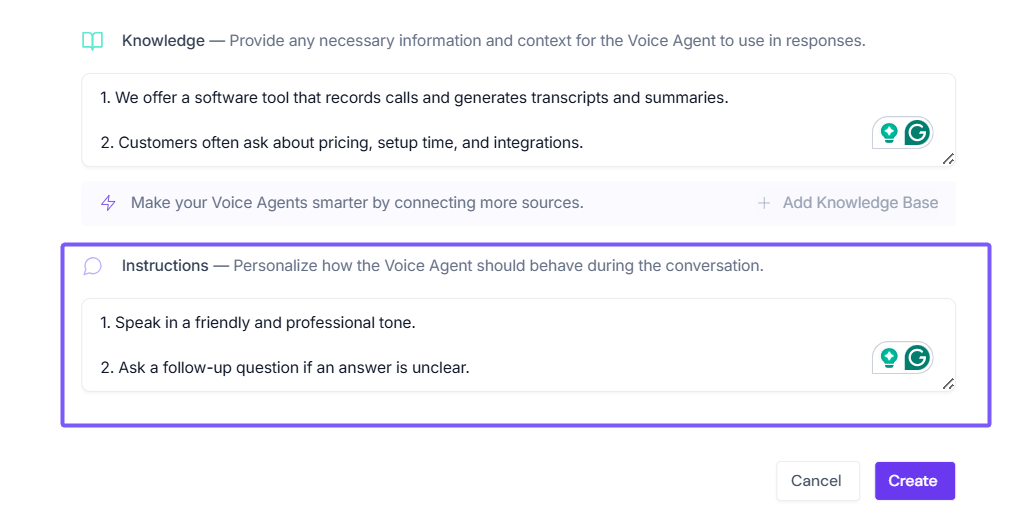
💬 Instructions — How your Voice Agent should behave
Instructions control how the Voice Agent speaks and responds.
How to use it:
Keep instructions simple and direct
Focus on tone, pacing, and follow-ups
Write them as guidance to a teammate
Example
“Speak in a friendly and professional tone.”
“Ask a follow-up question if an answer is unclear.”
3. Personalize your Voice Agent
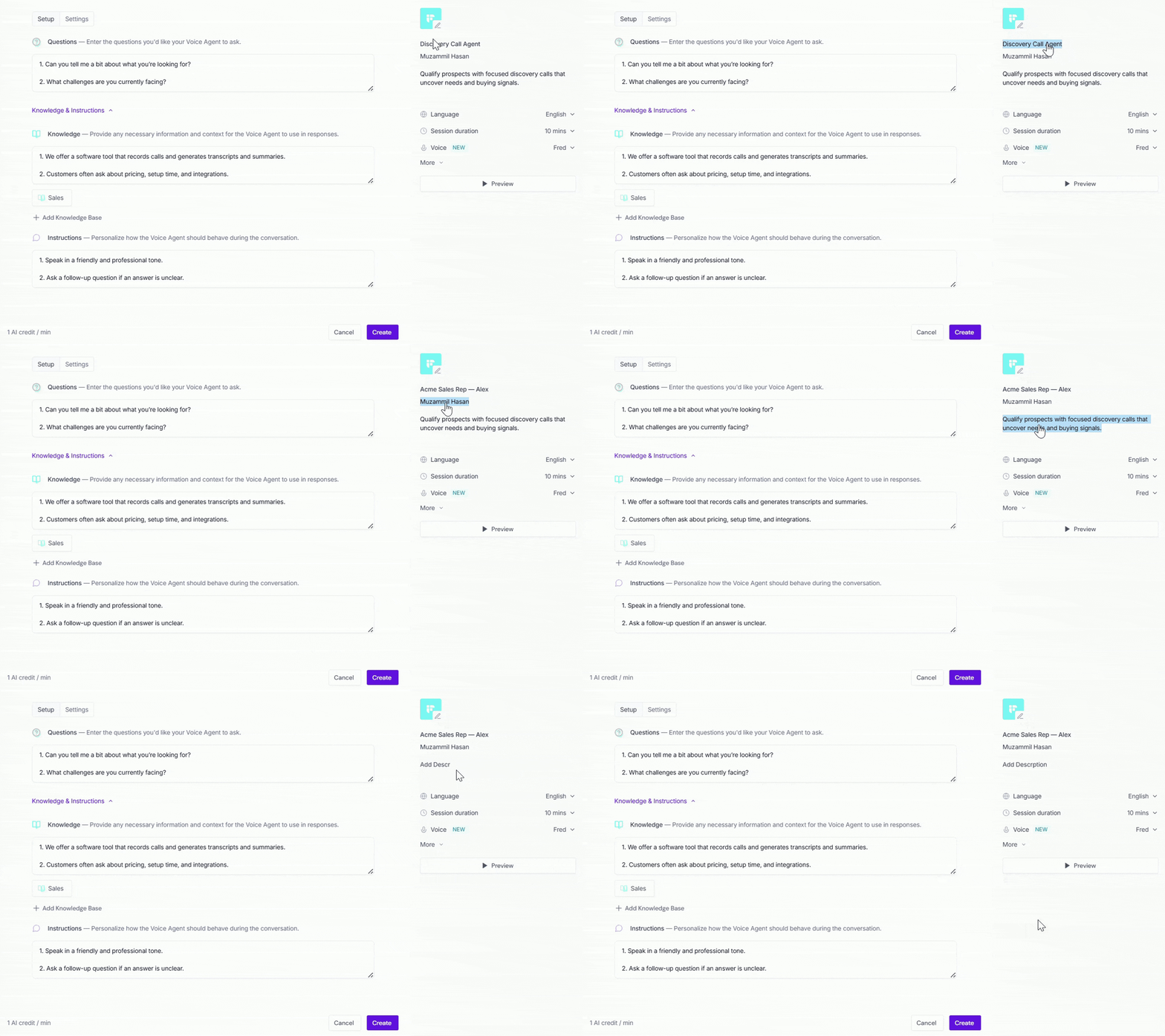
Step 1: Add your company branding
Customize how the Voice Agent appears to others.
Upload a logo → Add your company logo to represent your brand.
Give your Voice Agent a name → Choose a clear name that explains what the Voice Agent does
(for example, “Acme Sales Rep — Alex” or “Product Demo AI — Nova”).Update the company name → Edit the company name shown during the conversation, if needed.
Add a short description → Write a brief description so others understand the Voice Agent’s purpose.
These details help people understand who the Voice Agent represents and what the conversation is about.
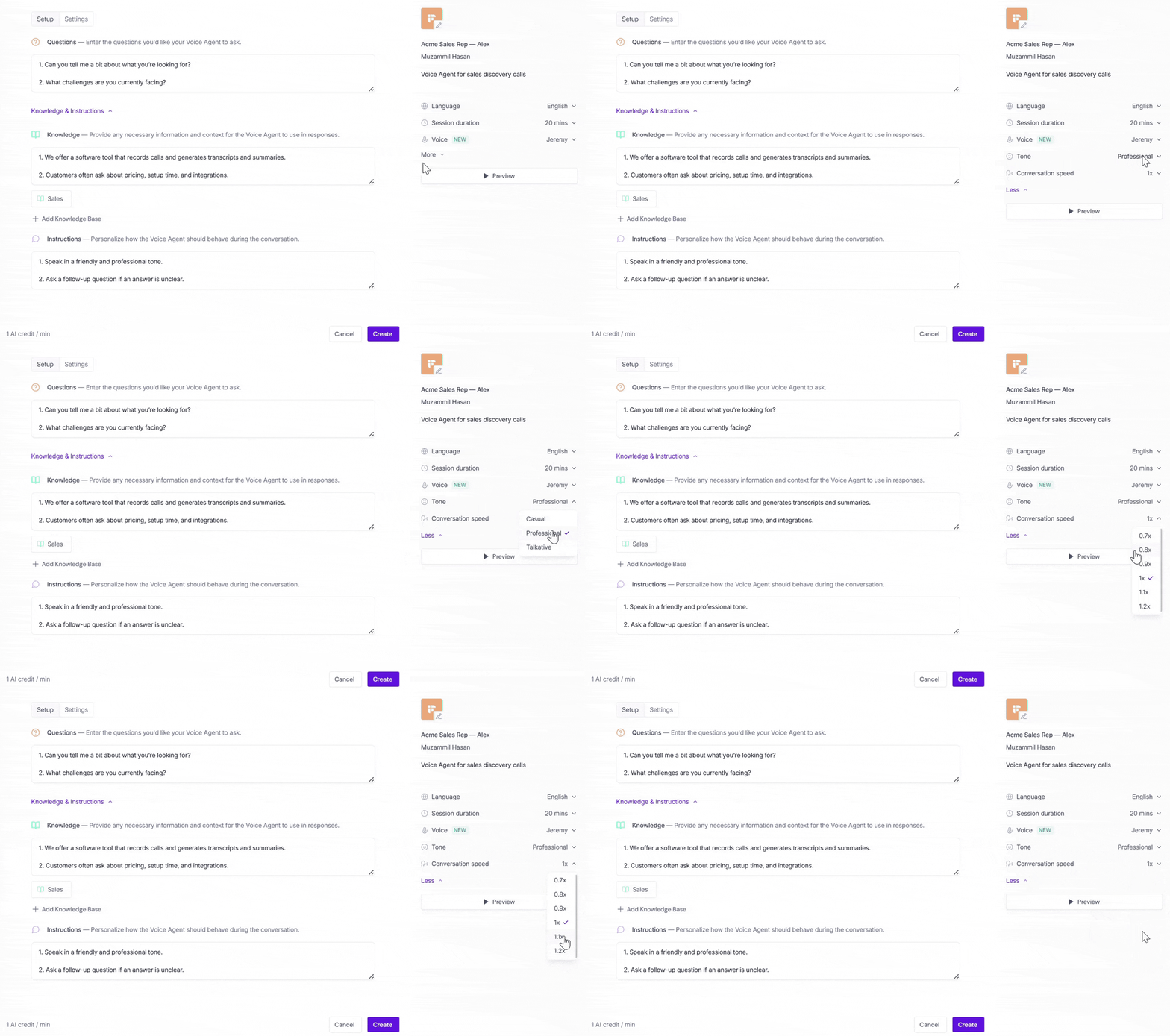
Step 2: Customize how your Voice Agent sounds and behaves
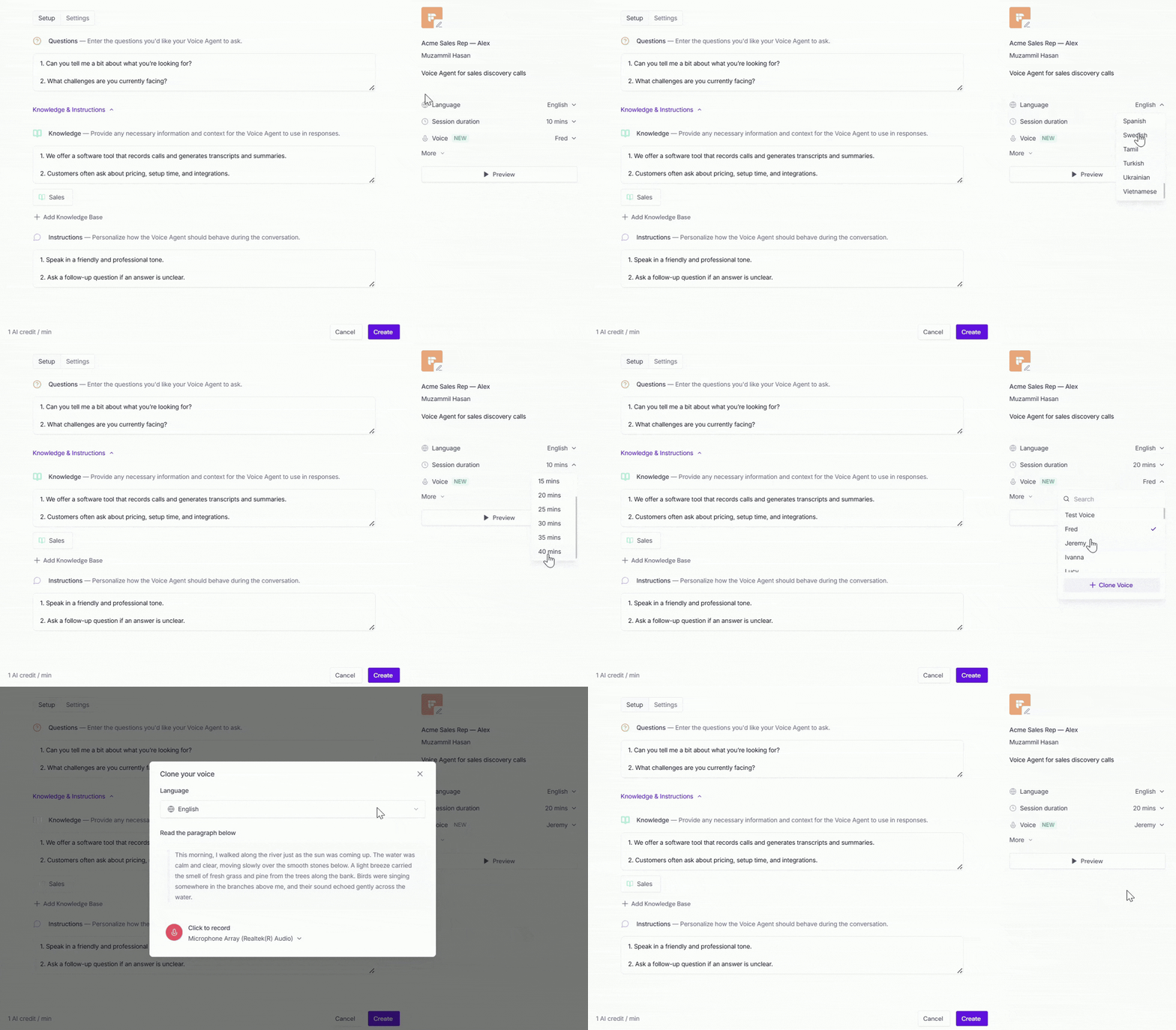
In this step, you decide how your Voice Agent sounds and communicates during a call. These settings affect how natural the conversation feels and how long it can run.
Language → Choose the language your Voice Agent will use while speaking with participants during conversations. Fireflies supports 32+ languages.
Session duration → Choose how long each conversation can run (5–40 minutes).
Voice → Choose how your Voice Agent will sound while speaking with participants during conversations.
Built-in voices: Choose from preset AI voices available in different languages for your Voice Agent conversations.
View available languages with built in voice count ✅
Language
Available Voices
English
25 voices
Hungarian
9 voices
Hindi
8 voices
Chinese
6 voices
Spanish
5 voices
French
5 voices
Turkish
4 voices
Russian
3 voices
German
2 voices
Use your own voice: Use your own recorded voice (voice cloning) instead of a preset AI voice, so your Voice Agent sounds more natural and personalized during conversations.
👉🏻 Check out How to Clone Your Voice for Fireflies Voice Agents to learn how to create and use your own voice.
Tone → Choose how your Voice Agent communicates, such as Casual, Professional, or Talkative.
Conversation speed → Control how quickly the Voice Agent speaks during the conversation (0.7x to 1.2x).
Step 3: Preview before finalizing
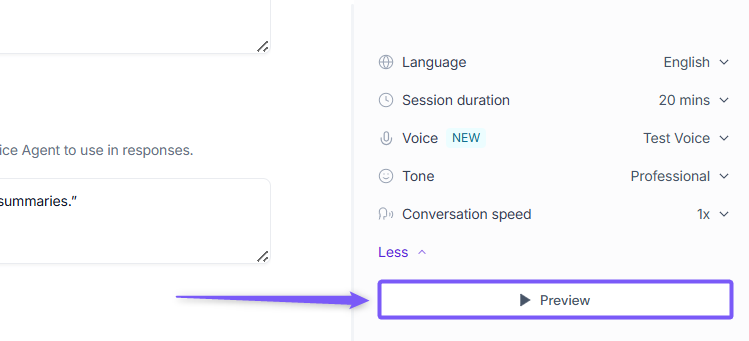
Use the Preview button to listen to how your Voice Agent will sound before publishing.
4. Set visibility, privacy, and recap email preferences
Review how meetings and summaries should be shared. The settings below help you control who can find the Voice Agent, who can view meeting details, and who receives updates after each call.
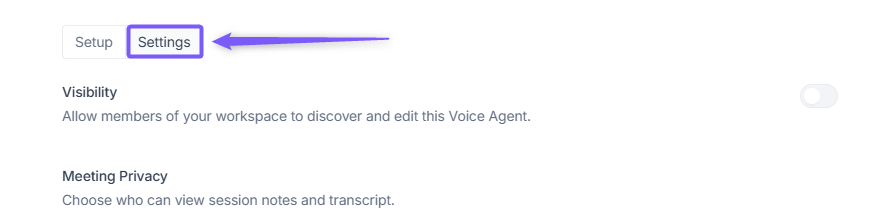
Select the Settings tab on the top left side to continue.
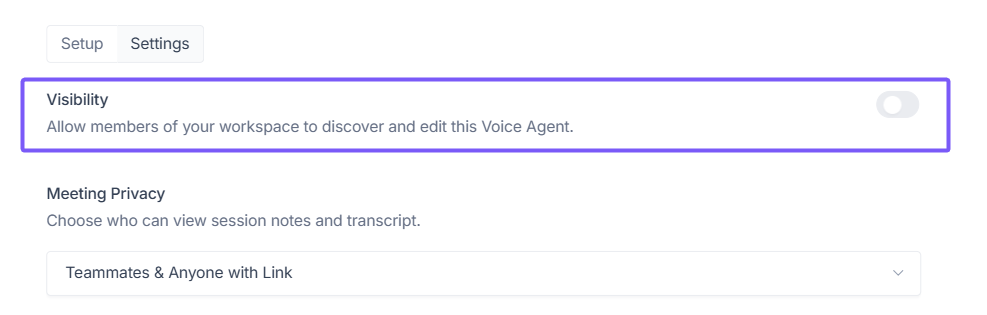
Visibility → Toggle this on if you want other members of your workspace to discover and edit this Voice Agent. Turn it off if you want only yourself (or admins) to manage it.
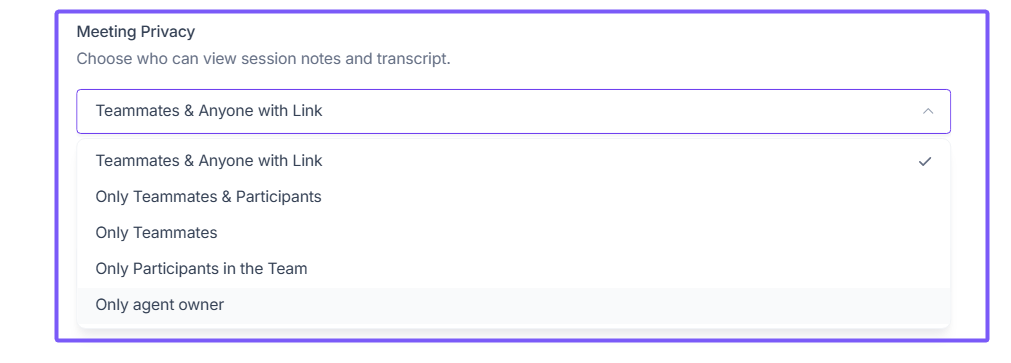
Privacy settings → Choose who can view meeting transcripts and recordings after a call. You can limit access to only yourself, share it with participants, make it available to workspace teammates, or allow access to anyone with the meeting link.
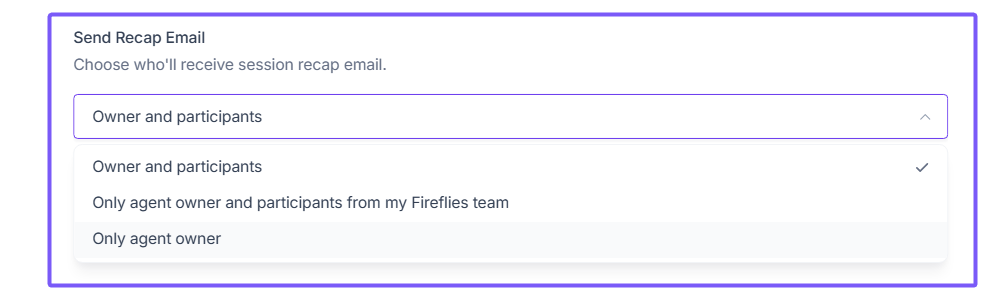
Recap email settings → Decide who should receive the call recap email after each call, such as only agent owner (you), only agent owner and participants from your team, or owner and participants.
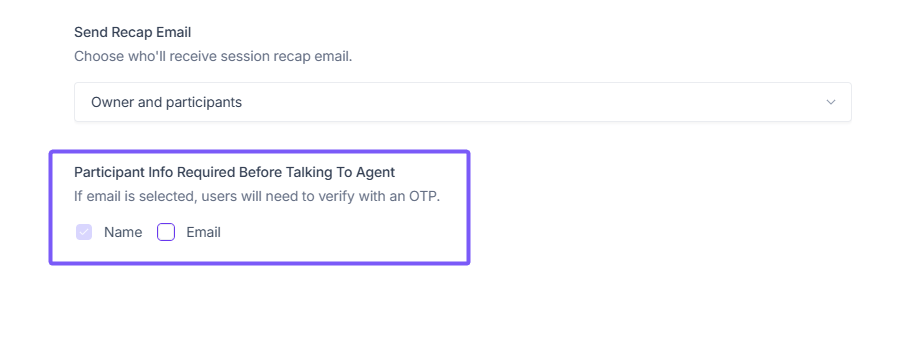
Participant info required before talking to agent → Choose what information participants must provide before starting a conversation. You can require name, email, or both.
If email is selected, participants will need to verify their identity using a one-time password (OTP) before joining the call.
If email is not selected, participants can simply enter their name and start talking right away — no verification required.
This setting is especially useful for demos, inbound conversations, or quick interactions where speed matters.
5. Make Your Voice Agent Live
Once everything looks good, click Create to make your Voice Agent live.
Once your Voice Agent is live, a shareable link is generated automatically. You can also distribute it via embed code, QR code, calendar invite, or messaging and social platforms — no scheduling required.
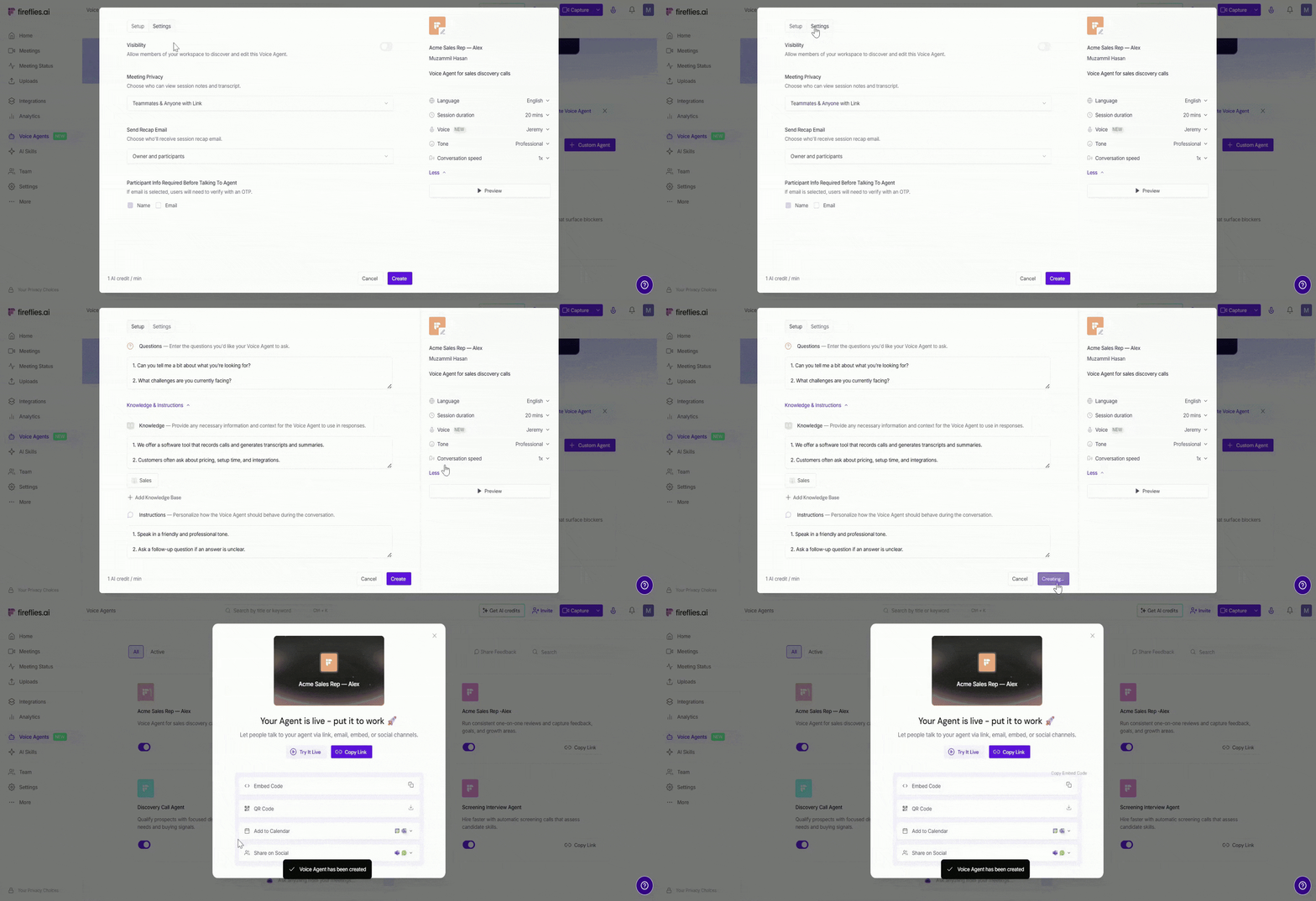
🔗 Don’t worry — You can return at any time to edit, pause, or unpublish the Voice Agent if needed.
6. Share your Voice Agent
You can share your Voice Agent in multiple ways, such as embedding it on your website, generating a QR code, sending it through messaging apps, or adding it to calendar invites.
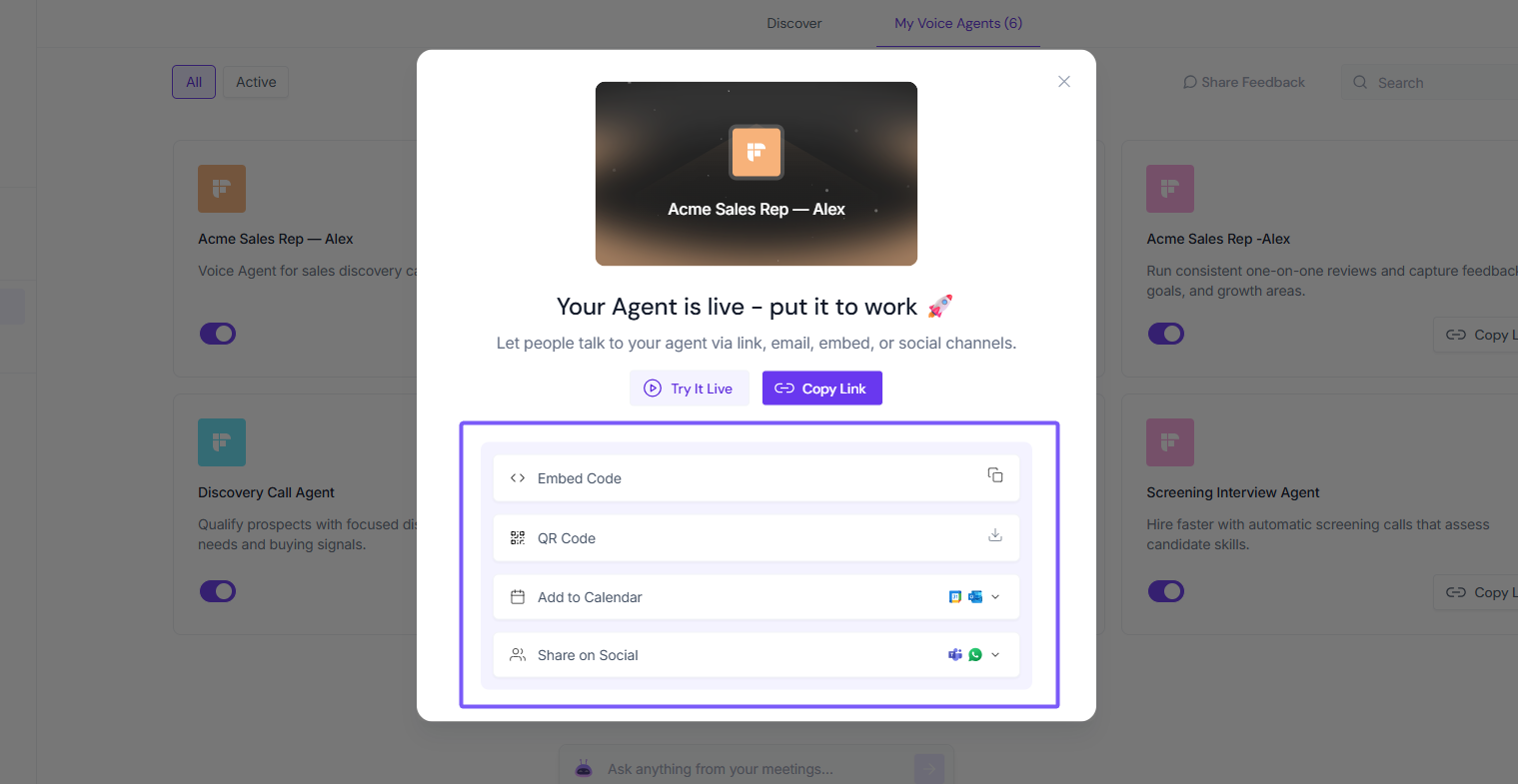
👉 Learn how to share your Voice Agent: Share Your Fireflies Voice Agent in Seconds — Embed, QR Code, Social Media, Calendar & More
👥 How participants join the call
When someone clicks your Voice Agent link, they’re guided through a simple join flow:
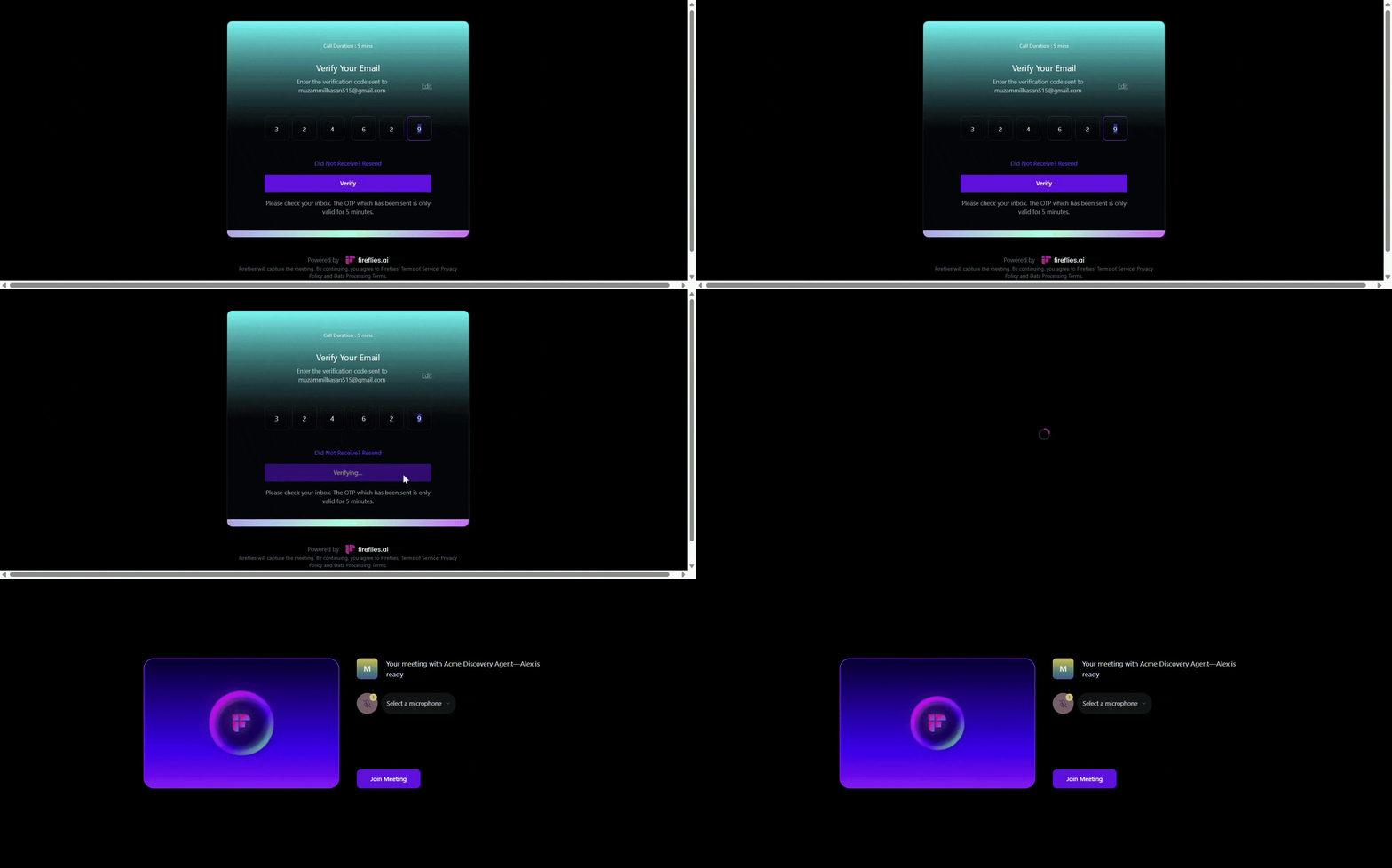
If email verification is enabled:
They enter their name and email.
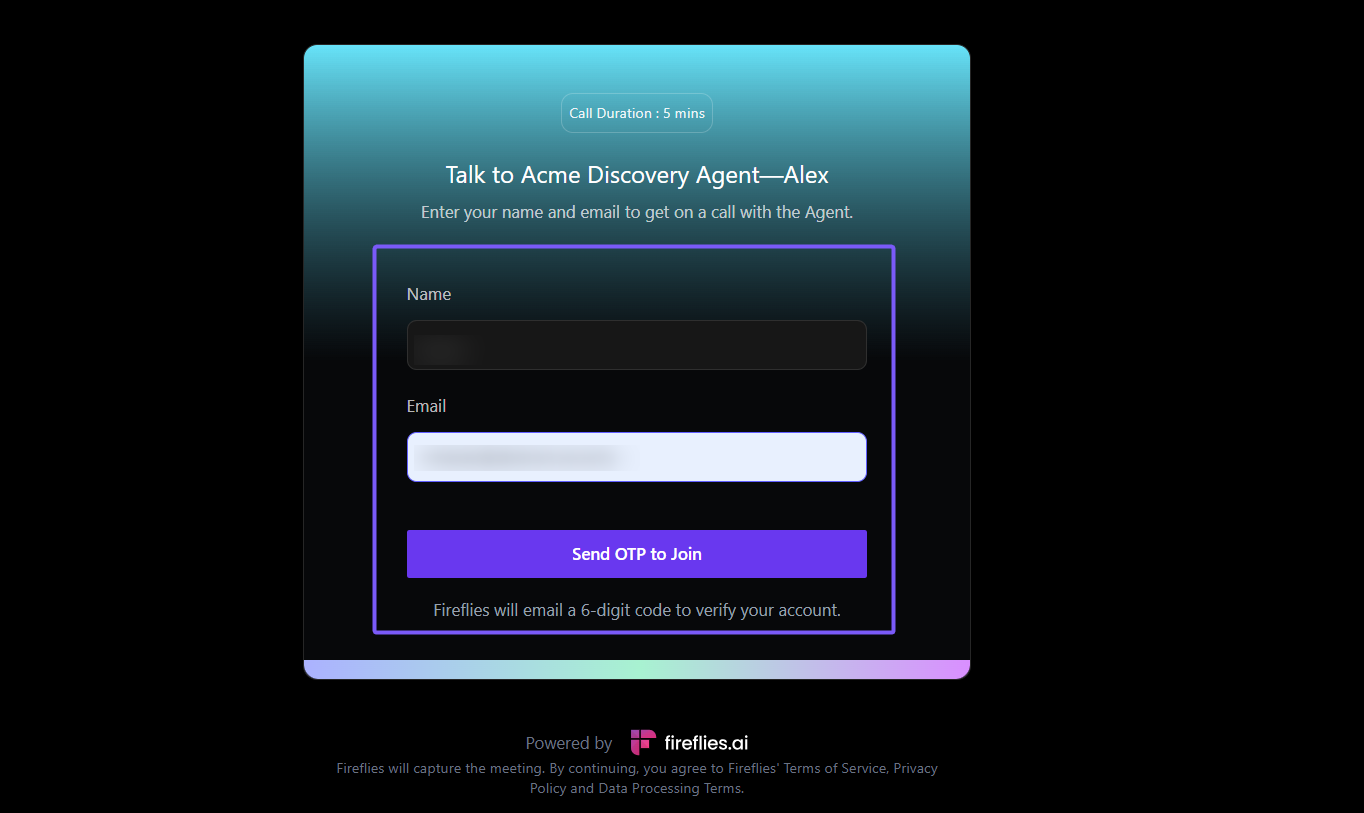
They verify their identity using a one-time password (OTP).
Once verified, they click Join Meeting.
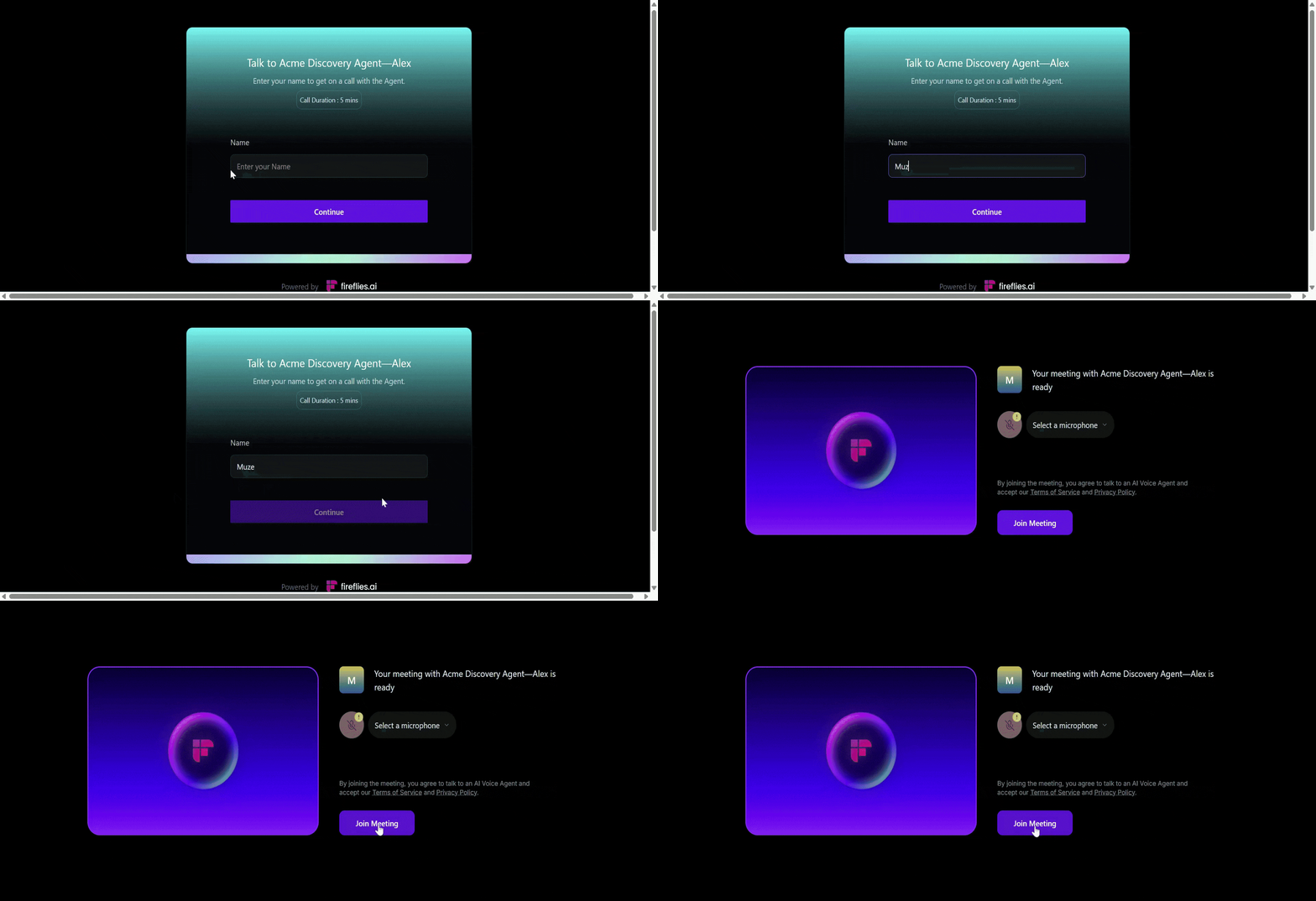
If email verification is disabled:
Enter your name and click Continue.
Click Join Meeting.
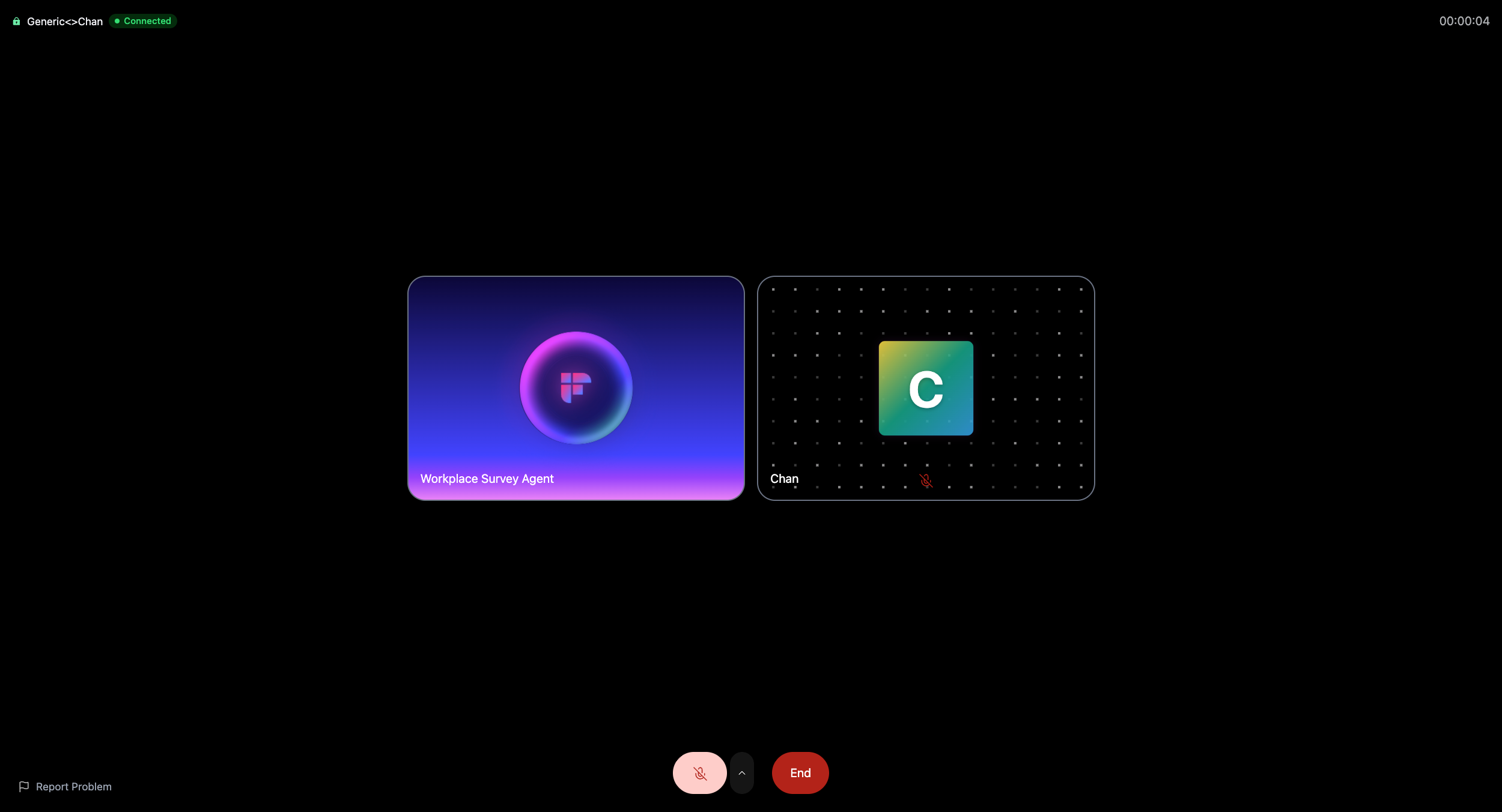
The conversation starts immediately.
🤖 How the Voice Agent runs the conversation
When a participant joins the call, the Voice Agent greets them and guides the conversation based on the questions, knowledge, and instructions you configured.
The Voice Agent can:
Ask questions and follow up naturally
Listen and respond in real time
Collect important information automatically
Keep the conversation structured and on track
This helps you run consistent conversations without needing to attend every call live.
✅ What happens after the call
Once a Voice Agent call ends, Fireflies automatically captures and organizes everything for you, so you can review outcomes and take action without replaying the entire conversation.
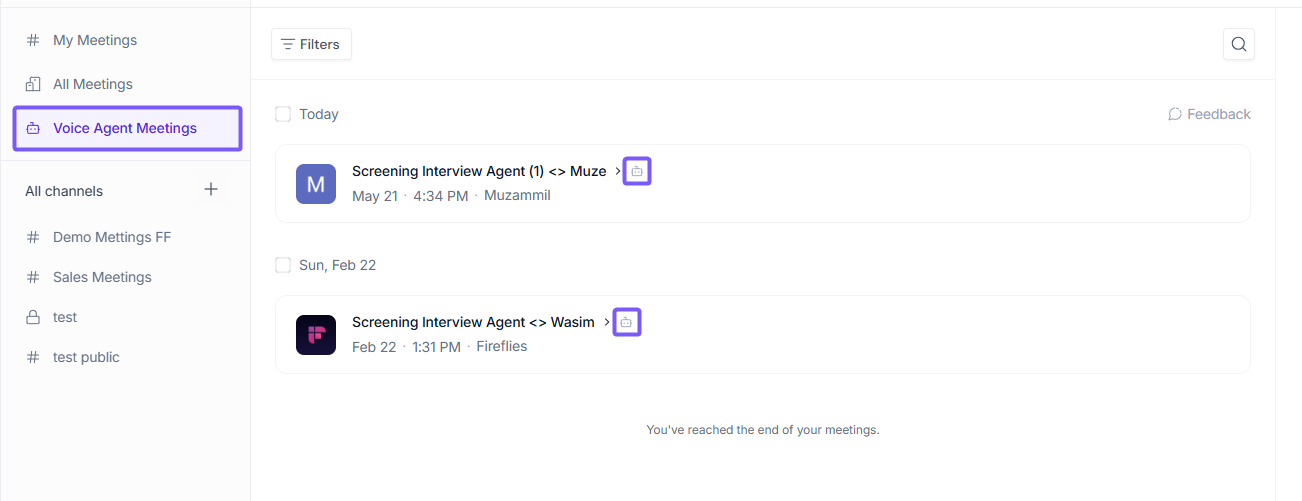
How to identify Voice Agent meetings?
Voice Agent calls are marked with a robot icon (🤖) next to the meeting name. This icon helps you quickly identify which meetings were run by a Voice Agent.
Alternatively, select the Voice Agent Meetings channel from the left sidebar to view all Voice Agent meetings in one place.
After each call, you can:
Review recordings and transcripts
View AI generated summaries and highlights
Review scorecards and evaluations
Use AskFred to get answers from the meeting
Run AI Skills to automate follow ups and workflows
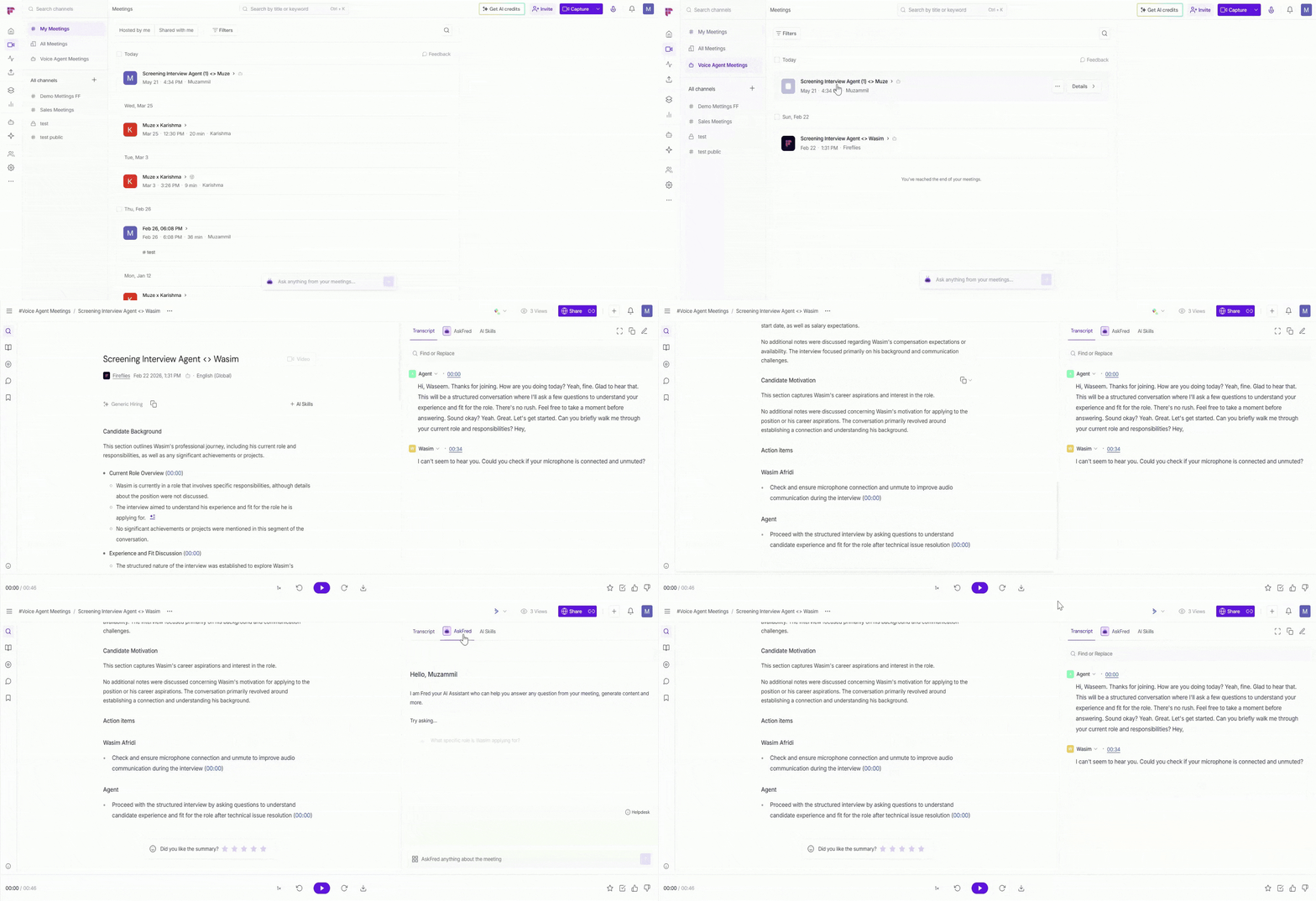
For step-by-step instructions on where to find the voice agent meeting and how to review outputs, see:
👉 Learn how to view and take action on your Voice Agent meetings
✨AI Credits Usage for Voice Agents
Voice Agents use AI credits based on how long each call lasts. Credits are consumed only while the call is active.
1 AI credit = 1 minute of Voice Agent call time
Only the actual duration of the call is counted
No credits are consumed before or after the call
For example, if a call runs for 10 minutes, it uses 10 AI credits
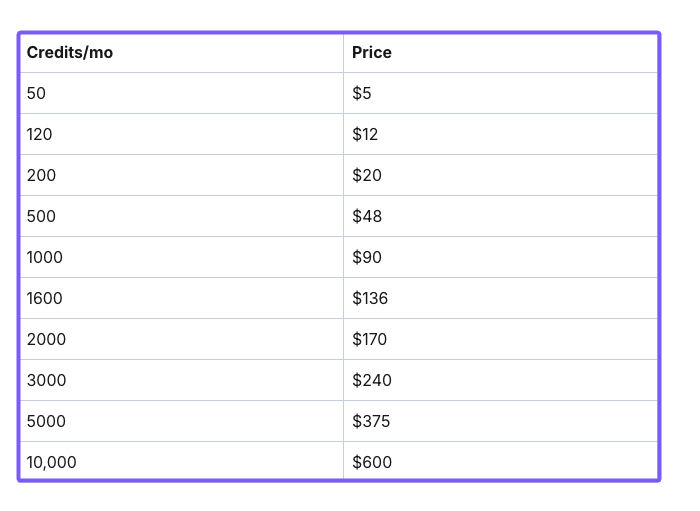
Learn more about purchasing AI credits: How to purchase AI credits
⚙ Manage your Voice Agent
After your Voice Agent is live, you can manage it anytime from the My Voice Agents section.
From there, you can edit the agent’s configuration, pause or unpublish it, clone it for another use case, or delete it when it’s no longer needed.
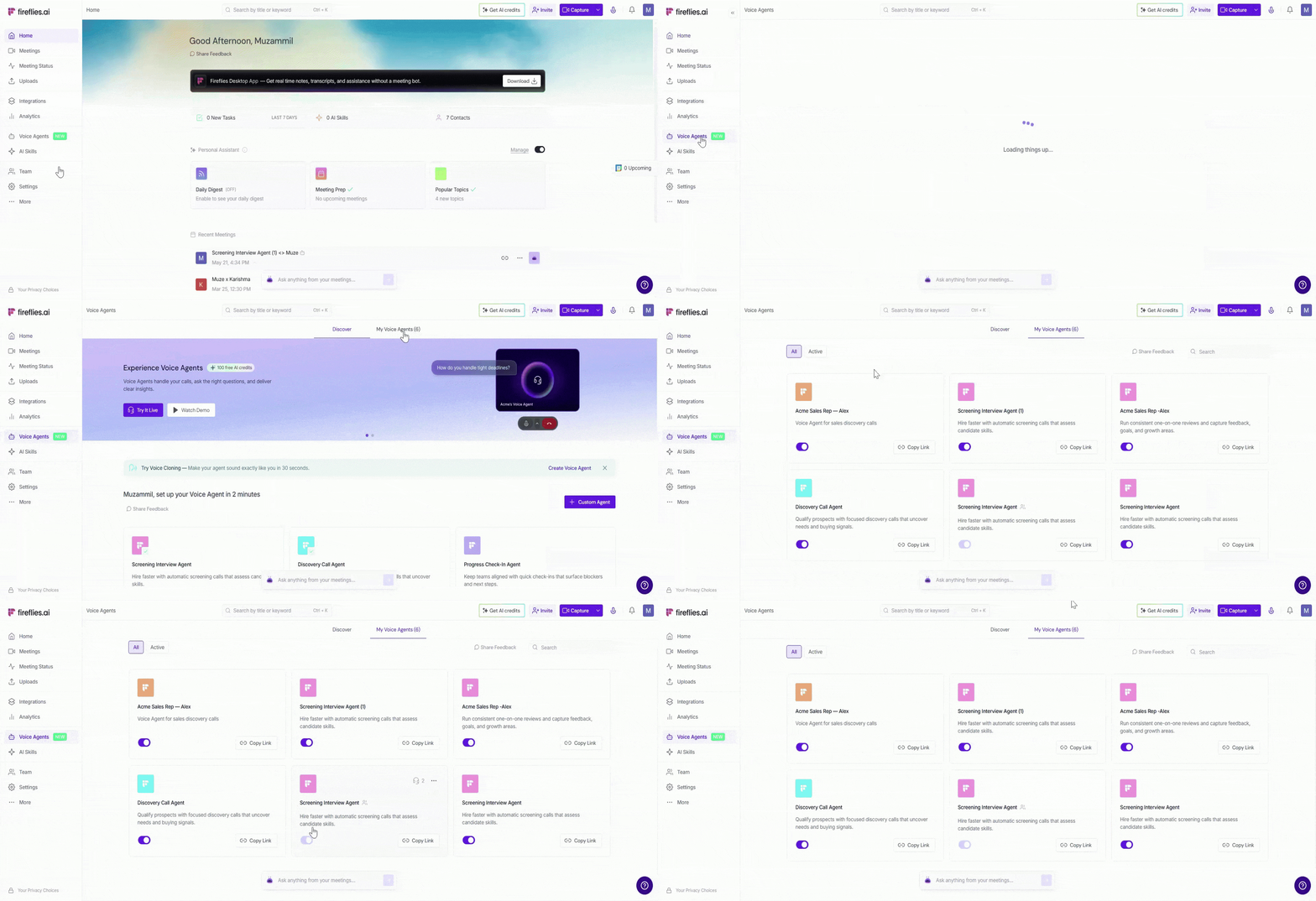
Learn more about how to actively manage your Voice Agents in How to Manage Your Voice Agents.
❓ Troubleshooting & FAQs
1. I can’t find my Voice Agent
Go to Voice Agents → My Voice Agents and make sure the agent is published or not paused.
2. My Voice Agent link isn’t working
Check that the agent is published and try opening the link in an incognito window to test it.
3. Participants can’t join the call
Ask them to confirm their email and complete the one-time password (OTP) verification before starting the meeting.
4. I don’t see the call after it ends
Calls appear once the Voice Agent finishes running. Check Meetings → Voice Agent Meetings or All Meetings.
5. The summary or transcript is missing
It may take a few moments to generate after the call ends. Refresh the meeting page and check again.
6. Who can view Voice Agent calls?
Access depends on the visibility and privacy settings you chose when creating the Voice Agent. If needed, check the agent’s settings or contact your workspace admin.
7. Do Voice Agent calls use Google Meet or another third-party platform?
No. Voice Agent calls run entirely on Fireflies’ own platform. Participants simply open the shared Voice Agent link in any browser—there’s no Google Meet or third-party meeting tool involved.
8. Can I change or customize a Voice Agent template after selecting it?
Yes. Once you choose a template, you can fully customize it—including questions, knowledge, instructions, voice, tone, and privacy settings—before publishing. Templates are just a starting point and can be edited at any time.
9. Can I use my own voice for a Voice Agent?
Yes. Fireflies supports Voice Cloning, which allows you to create and use a custom voice clone for your Voice Agents.
📌 Check out How to Clone Your Voice for Fireflies Voice Agents to learn how to create and use your cloned voice.
🔁 Recap
Here’s a quick summary of what you covered:
Choose a Voice Agent template
Customize questions, knowledge, and behavior
Adjust visibility and privacy settings
Publish the agent and share the link
Review calls and outputs after each conversation
Manage or reuse the agent later
🔗 Related guides
How to Create a Discovery Call Voice Agent → Step-by-step instructions for setting up a Discovery Call Voice Agent.
How to Create a Screening Interview Voice Agent → Step-by-step instructions for setting up a Screening Interview Voice Agent.
How to Create a Voice Agent from Scratch → Learn how to build a completely custom Voice Agent from scratch.
How to Clone Your Voice for Fireflies Voice Agents → Create and use a custom voice clone for your Voice Agents.